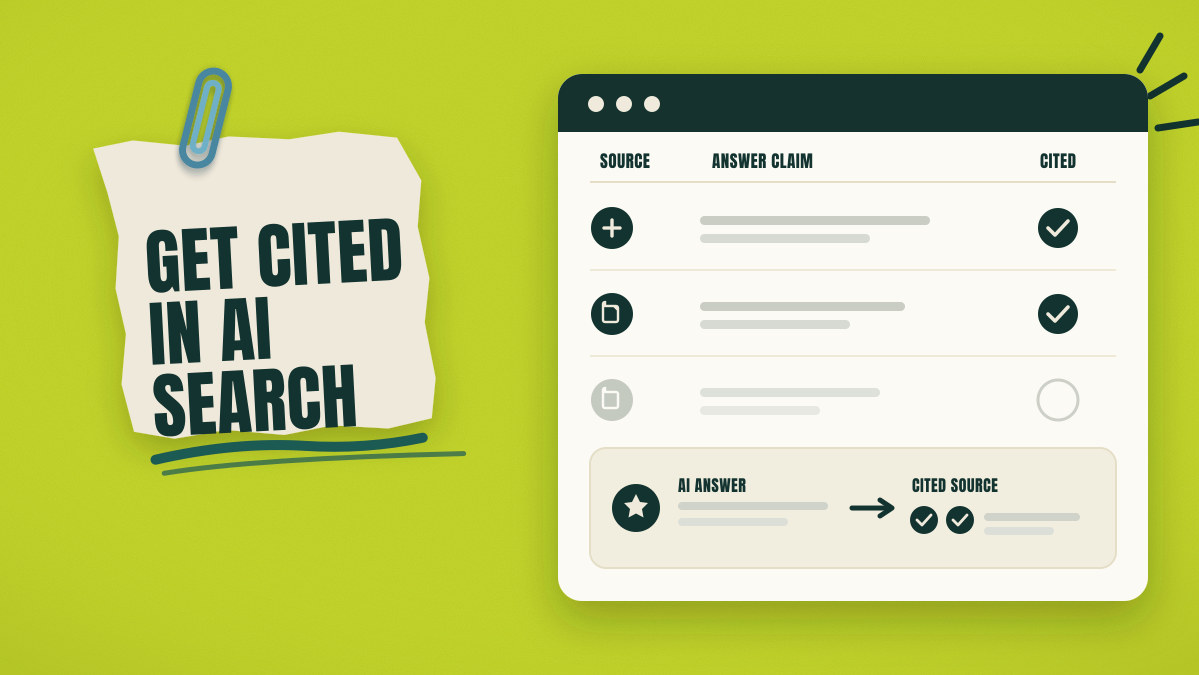
AI citations require discovery, usable evidence, and successful source selection. A useful SOC 2 readiness page may lose citations to competitor articles.
Learning how to get cited in AI search results starts with diagnosis. Citation loss differs from ranking loss because several hidden decisions precede source attribution.
Prompt → access → evidence → citation
A March 2026 Ahrefs study found 38% citation overlap with Google top-ten results. Its dataset covered four million cited URLs across 863,000 result pages. Treat that Ahrefs finding as context, never a permanent platform rule.
What Does an AI Citation Actually Prove?
An AI search citation connects one source page with one answer claim. Citation presence never proves endorsement, shortlist inclusion, traffic, or revenue. Teams need separate records for every later business outcome.
| Signal | Visible result | Business value | Required record |
|---|---|---|---|
| Citation | Linked source | Source exposure | Cited URL and supported claim |
| Mention | Brand name | Brand recognition | Brand mention count |
| Recommendation | Brand shortlist | Buyer consideration | Recommendation count |
| Referral | Website visit | Direct engagement | Referral session |
| Conversion | Enquiry or sale | Commercial value | CRM record |
One answer can cite research while recommending another provider. Review the difference between citation and brand mention before assigning revenue credit.
A Citation Must Survive 7 Separate Decisions
Citation visibility contains seven dependent decisions across search, retrieval, generation, and attribution. Failure during an earlier decision removes every later opportunity.
1. Search activation
The product first decides if web retrieval supports the prompt. An answer without web sources cannot test any page citation eligibility.
2. Access
The search agent requests a candidate URL. Network and firewall controls inspect every incoming request. Returned HTML must include the main information without failed rendering.
3. Retrieval
One prompt can produce several related searches. Google documents concurrent query fan-out for broader information gathering. Each related need requires a suitable page matching reader intent. Index presence alone never secures retrieval or source citation.
4. Reranking
Retrieved documents compete for limited answer context through private commercial product systems. Publishers cannot inspect platform weights or force source placement directly.
5. Evidence use
Generation selects information supporting individual answer claims. Source wording may influence only one generated answer sentence. One cited page may contribute narrowly scoped facts.
6. Attribution
The interface displays a source link beside supported information. Link placement, source panels, and labels vary across individual product interfaces.
7. User response
A visible citation can create exposure without producing visits. Referral sessions can occur without producing qualified enquiries. Sales attribution needs analytics, CRM records, and agreed commercial definitions. Commercial value closes the full measurement chain.
Research boundary: The foundational GEO research paper tested documents already supplied within fixed test contexts. The experiment lacked live retrieval tests across commercial products. A 2026 critical GEO review found limited long-term evidence covering conversion effects.
Step 1: Choose a Buyer Question Your Business Can Support
Choose an AI search query connected with buyer decisions and company evidence. Broad definitions attract broad answers with weak provider relevance. Commercial questions expose required expertise, scope, and proof. One suitable page should own each selected buyer decision alone.
Move from broad interest toward commercial need
- Broad: What does SOC 2 cover for growing technology companies?
Creates broad awareness without supporting provider selection. - Focused: What preparation occurs before a SOC 2 audit?
Surfaces operational readiness requirements before choosing any provider. - Commercial: What should a 50-person Indian SaaS company prepare before auditor selection?
Connects specific evidence requirements with vendor consideration.
Add modifiers only when they change the answer. Company size changes available owners, budgets, and process complexity. Geography can change legal context, vendor access, and procurement requirements. Project stage changes the next useful decision.
Qualify every target question
- Connect the question with a commercial decision.
- Confirm internal experts can support the required answer fully.
- Identify available records before funding content production.
- Assign one existing or planned page as question owner.
- Inspect cited competitors for missing scope or evidence.
- Define a repeatable test covering source presence and accuracy.
Map each prompt to one suitable page
| Buyer prompt | Intent | Required page | Evidence requirement |
|---|---|---|---|
| Readiness work | Requirement | Readiness article | Official criteria and implementation records |
| Project price | Cost | Pricing article | Scope variables, currency, date, exclusions |
| Provider selection | Comparison | Selection article | Credentials, process, case evidence |
| Audit timeline | Planning | Process article | Stages, dependencies, owner responsibilities |
A useful query map forms explicit knowledge relationships. Each prompt has buyer intent and relevant commercial modifiers. Every query maps toward one accountable page. Every source page requires evidence matching its commercial claim.
Step 2: Record a Baseline Before Changing Any Page
A baseline records identical prompts across controlled testing conditions. Later tests need comparable conditions before movement carries analytical value. AI citation tracking without source captures produces anecdotes without operational evidence.
Record every condition that can change output
| Field group | Fields |
|---|---|
| Platform | Product, mode, model label |
| Context | Country, interface locale, signed-in state |
| Prompt | Exact wording, paraphrase group, commercial intent |
| Answer | Search activation, full output, displayed sources |
| Brand | Mention, recommendation, factual description |
| Citation | URL, supported claim, source position |
| Time | Date, hour, sequence number |
Store screenshots or exported answers beside every record. Source interfaces can change after initial documented evidence collection. A saved artifact protects later review from avoidable memory errors.
Apply seven testing controls
- Preserve exact prompt wording across every comparison test.
- Open fresh conversations for each controlled prompt attempt.
- Record search activation before examining displayed source links.
- Save absent results alongside every positive source result.
- Repeat each prompt during one defined testing window.
- Separate consumer interfaces from developer API outputs.
- Record factual errors beside positive wording about brands.
Create an AI Citation Baseline Sheet using these columns. Assign one analyst, one testing calendar, and one version convention. A separate measurement method can support wider reporting.
Step 3: Confirm Every Search Platform Can Reach the Page
Search crawler permission creates basic access eligibility. Successful retrieval also needs network delivery, suitable index controls, and useful returned content. Training permission serves another separate publisher purpose. Blocking one agent never defines every product experience.
Separate search, user-fetch, and training agents
| Platform | Search agent | User-request agent | Training agent |
|---|---|---|---|
| Google AI features | Googlebot | Product dependent | Google-Extended controls named uses |
| ChatGPT Search | OAI-SearchBot | ChatGPT-User | GPTBot |
| Perplexity | PerplexityBot | Perplexity-User | Separate published controls |
| Claude | Claude-SearchBot | Claude-User | ClaudeBot |
| Bing and Copilot | Bingbot | Product dependent | Separate published controls |
OpenAI crawler documentation separates OAI-SearchBot, ChatGPT-User, and GPTBot. Perplexity crawler documentation describes PerplexityBot and Perplexity-User as separate roles. Anthropic crawler documentation separates ClaudeBot, Claude-SearchBot, and Claude-User independently.
That distinction prevents an expensive diagnostic error. Allowing GPTBot controls potential training access, never ChatGPT Search inclusion. Review the SEO Noida OAI-SearchBot access rules for practical implementation details. The broader AI crawler roles reference covers retrieval categories.
Inspect technical access in dependency order
- Request the production URL; record response code, headers, and content.
- Confirm HTTP 200 while flagging soft 404 responses and challenges.
- Inspect redirects for destination relevance, protocol, host, and status.
- Match robots groups against exact tokens and inherited directives.
- Verify crawler identity through published network information where available.
- Inspect content delivery network events for blocks, limits, and challenges.
- Review canonical, noindex, and snippet controls together.
- Compare returned HTML against principal visible evidence.
Check mobile and desktop responses where infrastructure treats them differently. Inspect JavaScript output when initial HTML lacks critical evidence. Compare canonical destinations against submitted sitemaps and descriptive internal link signals. Fix conflicting access controls before rewriting page copy.
Crawler warning: A copied user-agent string cannot establish crawler identity. Server logs need network verification whenever platforms provide it. Permission only permits access; retrieval, selection, and citation remain separate decisions.
Teams needing deeper technical remediation can review technical SEO for AI search. Preserve log evidence before changing firewall or robots controls.
Step 4: Build a Page Worth Using as Evidence
A cited source page answers one question and supports consequential claims. Formatting improves reader access, while strong evidence establishes source value.
Give One Page One Main Reader Question
Assign one page owner for each priority question. Match page purpose with the exact buyer decision under consideration. Retain only related and necessary supporting questions. Remove unrelated services, locations, and definitions from the principal page answer. Link separate buying intents toward dedicated pages with suitable evidence.
Use three content layers:
- One main buyer question
- Several supporting questions serving that decision
- Separate pages covering separate commercial decisions
Put the Answer Before Background Information
Weak opening
SOC 2 has become important across modern technology businesses. Many companies seek stronger compliance and measurable customer confidence signals.
Improved opening
A security lead should name control owners before seeking audit proposals. Collect policy approvals, user lists, deployment tickets, supplier reviews, and incident logs for scope discussions. Confirm examination requirements with a qualified CPA firm before signing advisory work.
The improved block names a defined company. It identifies required preparation work immediately for buyers. Scope, evidence categories, project stage, and professional boundaries appear together. Buyers can compare internal readiness against provider requirements.
Direct answers need enough context for accurate reuse. A tiny answer can remove exclusions or named subjects. A long historical opening can bury the important decision entirely. Use the shortest sufficient answer serving the reader.
Attach Evidence Beside Every Consequential Claim
Evidence should appear near the claim it supports. Consequential statements deserve stronger records than introductory explanatory claims. Match each source type with factual risk and commercial importance.
| Claim type | Suitable evidence |
|---|---|
| Platform behaviour | Current official platform documentation |
| Legal obligation | Statute, court, or regulator publication |
| Health statement | Clinical or public-health evidence |
| Product capability | Current manufacturer specification |
| Company result | Approved analytics and project record |
| Price | Currency, scope, date, and exclusions |
| Expert recommendation | Named expert reasoning and credentials |
Every number needs a traceable source and defined scope. The cited record must support every part of the attached claim. Every dated fact needs a scheduled review date. Company outcomes require approved source records and documented calculation notes.
Never cite a home page for a detailed statistic. Link the exact document, dataset, standard, or reporting source page. Record publication date, access date, source owner, and review frequency internally. Remove any claim whose supporting record remains unavailable.
Add Information Competitors Cannot Reproduce
Original company knowledge creates distinctive source value. Generic summaries repeat material already available across competing pages. Direct experience contributes implementation details, limits, and observed failure patterns. Operational records expose useful decision criteria for buyers. Such evidence can help buyers compare options before contacting providers. Never manufacture surveys, benchmarks, clients, or outcomes.
Useful original evidence can include:
- Anonymised project findings with sample size
- Original calculations with visible methodology
- Decision criteria used during delivery
- Repeated failure patterns from approved records
- Product tests with conditions and limitations
- Before-and-after screenshots with sensitive details removed
- Named expert observations connected with direct work
Google recommends unique, useful, people-first information beyond recycled summaries. Its people-first content documentation also asks who created content and why. Original evidence serves readers first, then supplies distinct material for retrieval systems.
Preserve Meaning After Passage Extraction
Each important passage should retain meaning outside surrounding paragraphs. Include scope, attribution, dates, and limitations wherever omission could distort facts.
Apply these editorial checks:
- Named subject
- One principal claim
- Required measurement units
- Relevant date
- Geographic scope
- Important exclusions
- Evidence source
- Resolved pronouns
- Meaning preserved outside surrounding paragraphs
Extraction safety differs from forced content chunking. Editors should protect factual meaning and avoid invented passage formulas. Review content AI can retrieve and quote for deeper editorial checks. Commercial teams can also examine generative engine optimization services when internal capacity remains limited.
Step 5: Give Every Brand Claim One Verifiable Home
Brand entity consistency needs one approved record and accountable owner. Conflicting facts across pages and profiles create description errors. Consistent records support E-E-A-T through experience, credentials, authority, and factual accuracy.
Maintain an entity register
| Entity | Required facts | Primary owner |
|---|---|---|
| Organization | Name, category, headquarters, service area | About page owner |
| Person | Name, role, experience, credentials | Author profile owner |
| Service | Audience, scope, deliverables, exclusions | Service leader |
| Product | Model, specification, price, availability | Product manager |
| Location | Address, phone, hours, coverage | Operations manager |
| Case study | Context, period, work, outcome | Project owner |
Create one canonical record before updating public surfaces. Assign each fact a source, approver, publication date, and review date. Separate legal names from trading names through explicit labels. Record former facts without presenting them as current public facts.
The entity register should model factual relationships directly:
- Person
WORKS_FOROrganization - Organization
OFFERSService - Service
SERVESAudience - Organization
OPERATES_INPlace - Evidence
SUPPORTSClaim - Profile
IDENTIFIESOrganization
These relationships help editors detect contradictions before publication. They also support accurate Organization, Person, Service, and Place markup. Schema should describe accurate information visible across public pages. Hidden or inflated attributes create another conflict source.
Govern consequential claims through a ledger
| Claim | Supporting record | Owner | Review date | Published surfaces |
|---|---|---|---|---|
| Team experience | Employment history | Author owner | Scheduled date | Bio and About |
| Service area | Company operations record | Contact owner | Scheduled date | Contact and profiles |
| Campaign outcome | Analytics record | Case owner | Scheduled date | Case study |
| Certification | Issuing body record | Credential owner | Expiry date | Bio and service page |
| Product price | Approved price sheet | Product owner | Revision date | Pricing and sales assets |
One source record may support several accurate public descriptions. Each description should retain scope and date. Remove expired credentials and correct high-impact contradictions before expanding entity coverage.
Review entity SEO services and the brand-selection analysis for implementation depth.
Corroborate Important Claims Across Independent Sources
Independent sources should confirm important public claims without copying marketing text. Corroboration needs relevance, independence, and factual agreement. Repeated claims from controlled profiles still represent one organizational source.
| Claim | Suitable independent source | Rejected shortcut |
|---|---|---|
| Legal name | Government registry | Copied directory profile |
| Professional credential | Issuing body database | Self-written badge |
| Product capability | Current specification or manual | Affiliate rewrite |
| Customer experience | Verified review or approved project record | Invented testimonial |
| Research finding | Methodology and underlying dataset | Unsourced statistic roundup |
Match each claim with a source capable of verifying it. Government registries confirm legal names and registered locations. Issuing bodies confirm current certifications, while customers document experience within context.
Never purchase imitation consensus across disposable profiles. Remove contradictions before requesting editorial coverage or review updates.
Record every external source, supported claim, owner, and review date. Flag every source repeating unverified company marketing copy. Keep firsthand reviews separate from technical proof. Use corroboration for accuracy, never guaranteed citation placement.
Step 6: Match Each Check With the Relevant Platform
AI search platforms use different agents, indexes, interfaces, and reporting systems. A universal checklist misses platform-specific access controls and source displays.
| Platform | Confirmed foundation | Priority inspection | Available reporting |
|---|---|---|---|
| Google AI features | Google Search index | Indexing and snippet eligibility | Search Console generative AI report |
| ChatGPT Search | OAI-SearchBot | Bot and network access | Referral UTM and controlled tests |
| Perplexity | PerplexityBot | Bot, web firewall, returned content | Controlled tests |
| Claude | Claude-SearchBot | Search and user-fetch access | Controlled tests |
| Bing and Copilot | Bing index | Indexing and IndexNow | Bing AI Performance |
Google documents Search index retrieval and concurrent query fan-out. Eligible pages must support indexing and snippet display. Read Google AI feature documentation before diagnosing AI Overview absence.
ChatGPT Search starts with published search-agent permissions and reachable content. Perplexity access inspection starts with PerplexityBot, network controls, and returned HTML. Claude requires separate review for search retrieval, user fetches, and training preferences. Bing visibility begins with Bing indexing, then citation reporting.
Never convert observations into universal platform rules. ChatGPT and Perplexity source mixes vary across prompts and product modes. Google ranking cannot compel citations, while Claude selection exceeds one external index.
Record product, model, location, and search mode during every controlled test. LLM SEO services can support teams managing several platform workflows.
Practical Example: Rebuilding One SOC 2 Readiness Page
The following AI citation example uses a hypothetical Indian cybersecurity consultancy. No citation growth, traffic increase, or client result ever appears as fact.
Stage 1: Target
The team selects one commercially relevant readiness question. The target covers a 50-person Indian SaaS company before auditor selection.
Target card: Audience: 50-person Indian SaaS firm | Decision: auditor selection | Need: preparation evidence
Stage 2: Baseline
An analyst tests the prompt across five products and records search activation. Screenshots preserve each answer under its original test record.
| Baseline field | Recorded value |
|---|---|
| Product | Platform, mode, visible model label |
| Sources | URLs, positions, supported claims |
| Presence | Cited, named, shortlisted, absent |
| Context | Location, time, login state, exact prompt |
Official sources cover criteria, while vendor articles discuss readiness projects. No source combines company size, India context, owners, evidence, and auditor timing.
Stage 3: Source gap
The service page promotes consulting without answering the selected readiness question. An editorial gap card records missing source elements:
- Operational India context
- Named evidence owners
- Preparation limits
- Auditor independence
Editors approve the gap card before any page revision.
Stage 4: Page ownership
One readiness article owns the selected buyer question.
Own: Company size, India context, readiness work, evidence, auditor timing
Exclude: Service price, provider comparison, location pages, framework definitions
The title names audience, project stage, and required preparation work. The opening answers immediate readiness needs before background context.
Stage 5: Expert input
Practitioner interviews produce five approved inputs:
- Scoping questions from buyers
- Security and engineering control owners
- Evidence categories and collection owners
- Procurement limits
- Auditor independence boundaries
Interview notes separate direct experience from unsupported memory. Approved project records support recurring preparation patterns. Marketing memory cannot support numbers or unnamed client claims.
Stage 6: Evidence
Official criteria and consultancy experience need separate evidence roles.
| Claim group | Supporting source | Boundary |
|---|---|---|
| Framework category | AICPA Trust Services Criteria | Official framework context |
| Preparation pattern | Approved internal project record | Anonymised operational context |
| Consultancy outcome | Approved analytics record | Named scope and period |
| Attestation requirement | Qualified CPA source | Professional examination boundary |
Each consequential claim receives one matching evidence source. Evidence records store scope, date, method, approval, and publication location.
Stage 7: Access
The developer verifies access across five platform families.
- Record production response status and redirect destination.
- Match robots directives with each published search agent.
- Verify claimed agents through available network information.
- Inspect delivery-network blocks, canonical targets, and snippet controls.
- Confirm returned HTML contains principal evidence and dates.
Navigation and related links expose the page without orphaning it.
Stage 8: Retest
The analyst repeats original prompts under recorded conditions.
Retest record: Sources, claims, factual errors, brand presence, page version
Compare changed sources against every saved baseline capture. Report every observed change without claiming causal platform effects.
Before and after source blocks
Before
Our experienced SOC 2 consultants help growing technology companies achieve compliance efficiently. Contact our team for full readiness support and stronger customer trust.
After
A 50-person Indian SaaS company should assign control owners before auditor selection. Collect approved access, change, vendor, incident, and continuity records for the review period. Map each record toward the selected Trust Services Criteria. A qualified CPA firm must define examination requirements and provide attestation.
The revised block names company size, sector, preparation work, evidence, and stage. It also preserves the required professional services boundary. The paragraph can answer the prompt while surrounding sections supply deeper reasoning.
Step 7: Measure Citations Separately From Revenue
Citation activity measures source exposure across eligible sourced answers. Revenue analysis begins after visitors or assisted buyers enter recorded commercial processes. Teams should preserve each intermediate outcome without assigning unsupported sales credit.
Use one measurement ladder
- Search activation
- Page retrieval
- Visible citation
- Brand mention
- Brand recommendation
- Referral session
- Qualified enquiry
- Sale
Each measurement rung answers a distinct question. Citation rate measures source inclusion across tested eligible answers. Recommendation rate measures shortlist inclusion across commercial answers. CRM outcomes measure commercial value after acquisition records connect sessions with enquiries. Treat assisted conversions separately from last-click referral conversions.
Calculate three separate rates
Define eligible sourced answers before starting any calculation. Exclude answers lacking web retrieval from citation opportunity totals. Preserve each eligible-answer total across separate reporting periods. Report sample size beside every calculated rate.
Use first-party reporting where available
| Source | Useful fields |
|---|---|
| Google Search Console | AI impressions, pages, countries, devices, dates |
| Bing Webmaster Tools | Citations, pages, source-finding queries, trends |
| Analytics | AI referral sessions and landing pages |
| CRM | Qualified enquiries, pipeline, sales |
| Server logs | Verified search-agent access |
Google introduced a generative AI performance report within Search Console during June 2026. Bing introduced AI Performance reporting covering citations, source-finding queries, and trends. OpenAI publisher documentation assigns ChatGPT referrals their named UTM source.
Platform tests and first-party reports answer different questions. Controlled prompts inspect chosen commercial buyer questions. Platform reports expose broader visibility within available product data. Analytics and CRM connect visits with commercial outcomes.
Use the documented SEO Noida AI visibility measurement method for shared operational definitions. Teams needing implementation support can review AI SEO services.
Find the Exact Stage Where Your Page Loses
Each visible symptom points toward a different first technical inspection. Rewriting content wastes resources when access, indexing, or intent caused failure.
| Observation | Probable stage | First inspection |
|---|---|---|
| No sourced answer | Search activation | Product search mode |
| Page absent from Google | Indexing | URL Inspection |
| Navigation link only | Search access | ChatGPT search-agent controls |
| Competitor receives citation | Retrieval or evidence | Cited passage and page purpose |
| Brand named without owned source | External entity source | Source tracing |
| Page cited without brand | Evidence use | Supported claim |
| Incorrect company facts | Entity conflict | Claim ledger |
| Citation changes across repeats | Output variability | Test conditions |
| Citations increase without visits | User response | Referral data |
Start with the earliest observable citation failure. Inspect search activation before examining technical website eligibility. Inspect technical eligibility records before revising any source content. Review source construction and evidence quality before pursuing external corroboration.
Change one controllable layer during each testing cycle. Preserve all saved baseline records before each page modification. Document correlation without claiming private platform causation. An AI search visibility audit can coordinate those checks across owners.
8 Popular Tactics Cannot Guarantee AI Citations
No isolated tactic can force source selection across AI products. Publishers control access, evidence, facts, and testing discipline. Platforms control retrieval, generation, source display, and product changes.
1. Add llms.txt
Google ignores that file for Search visibility and rankings.
Other systems: Follow documented file-support rules
2. Add FAQ schema
| Schema role | Practical boundary |
|---|---|
| Useful | Labels matching visible facts |
| Insufficient | Cannot replace evidence or factual accuracy |
| Variable | Platform support and displayed features |
Use markup only when visible facts match every declared property.
3. Create tiny content chunks
Google requires no tiny content chunks for AI features. Passage accuracy remains valuable because extracted text needs preserved meaning.
4. Publish every query variation
- Scaled query pages can violate spam policies.
- Synonym pages can divide relevance signals across URLs.
- Create separate pages only for separate reader decisions.
- Preserve one owner for each commercial intent.
5. Allow GPTBot
Each agent needs its own documented publisher decision.
6. Purchase brand mentions
- Reject disposable profiles and paid pages disguised as editorial coverage.
- Seek references connected with verifiable expertise and original work.
- Record each supported claim and independent source location.
7. Reach Google position one
| Condition | Result |
|---|---|
| Google position one | Strong search visibility without guaranteed citation |
| Another AI platform | Separate access and source-selection system |
Required check: Direct citation measurement across every priority product
8. Add more words
Page length cannot replace evidence or intent ownership. Short pages can answer narrow questions with adequate evidence. Complex decisions may need longer treatment with complete supporting records.
Google documentation explicitly rejects forced chunking, AI-only rewrites, and separate special file treatment. Its generative AI optimization documentation prioritizes foundational SEO and useful non-commodity content.
A 90-Day Citation Improvement Sequence
The 90-day sequence orders work, evidence collection, and review ownership. It creates comparison points without promising citation selection.
| Period | Work | Owner | Output |
|---|---|---|---|
| Days 1–10 | Prompt baseline | Analyst | Source record |
| Days 11–20 | Access audit | Developer | Access register |
| Days 21–30 | Page ownership | SEO lead | Query map |
| Days 31–50 | Evidence collection | Subject expert | Claim ledger |
| Days 51–65 | Page revision | Editor | Revised source page |
| Days 66–75 | Entity correction | Brand owner | Updated facts |
| Days 76–90 | Repeated testing | Analyst | Comparison report |
Days describe project order and never predict citation movement. Indexing schedules, retrieval competition, and product variation remain outside publisher control. Teams receive named owners, review dates, and auditable outputs.
Hold one decision meeting after each period. Approve completed evidence records before publishing page revisions. Escalate unresolved technical access failures before beginning any content revisions. Archive every test artifact with its matching page version. Each owner signs the listed output before handoff. The analyst records unfinished dependencies beside every documented handoff.
Frequently Asked Questions
Can Any Agency Guarantee an AI Citation?
An agency can guarantee completed deliverables, never independent citation placement. Contracts should name access checks, page revisions, test samples, and reporting intervals. Reject contracts promising placement inside external AI products.
Can a PDF Earn an AI Search Citation?
Google lists PDF among its indexable document formats, yet citation selection remains separate. Put title, publisher, date, scope, and selectable text inside files. Link important PDFs from relevant HTML pages using descriptive internal anchors. Keep primary buyer actions available within accessible HTML pages.
Should Translated Pages Use Separate URLs?
Use separate URLs when each translation serves a defined audience. Add accurate hreflang references between equivalent regional versions. Google recommends distinct public URLs within its localized-page documentation. Localize prices, regulations, examples, and regional contact options where relevant. Never combine unrelated markets inside one answer block.
Can Paywalled Content Earn AI Citations?
Paywalled pages may earn citations when platforms can access usable material. Expose an accurate public summary covering scope and principal findings. Label restricted sections before account or payment requests. Never show crawlers materially different claims from reader copy. Place critical buyer decisions outside inaccessible promotional previews. Test each product under applicable publisher and crawler controls.
How Should Updated Claims Preserve Source Trust?
Show a revised date after material facts change. Retain original publication dates beside revision information. Update citations when underlying documents change scope or version. Archive prior source records within internal evidence files. Remove obsolete numbers from headings, summaries, and reusable passages. Record page versions beside every controlled citation test. Assign one owner for future factual reviews.
When Should a Page Offer Downloadable Data?
Offer downloadable data when readers need calculations, filtering, or reuse. Publish field names, units, dates, and geographic scope. Describe sampling, exclusions, and missing values beside each dataset. Connect every chart with its underlying record. Use stable file names and visible revision dates. Link datasets from the relevant narrative page. Keep principal findings readable without opening external software. Remove personal or confidential records before publication.
Can a Small Website Earn AI Citations?
Focused small websites can earn citations through narrow expertise and original evidence. Accessible pages, accurate entities, and focused answers create eligibility.
Should I Revise an Existing Page or Publish Another?
Revise when one page already owns the same buyer decision. Preserve its URL when history, links, and intent remain commercially useful. Publish another page when buyers need another decision outcome. Separate pricing, comparison, location, and process needs. Check existing pages before approving a new URL. Merge near-duplicates sharing the same buyer purpose and supporting evidence. Redirect removed URLs toward the strongest relevant owner. Update all descriptive internal links after every page consolidation. Retest original prompts after indexing processes the revision.
Find the First Citation Stage Blocking Your Page
Citation visibility depends upon several connected decisions beyond formatting tactics. Access failures, weak evidence, and entity conflicts require corrections. Accurate diagnosis protects budget and editorial resources. The SEO Noida audit identifies evidence-backed priorities for every internal owner.
Find where your page loses citation eligibility

Manish Singh is Head of Generative AI at SEO Noida and has 14+ years of experience in SEO, UX, and digital marketing. He focuses on how Google and AI platforms find, interpret, and cite web content. His articles cover AI SEO, GEO, AEO, LLM SEO, entity optimization, content architecture, and visibility measurement, drawing on website audits and campaign work.